The Independent Uganda: You get the Truth we Pay the Price


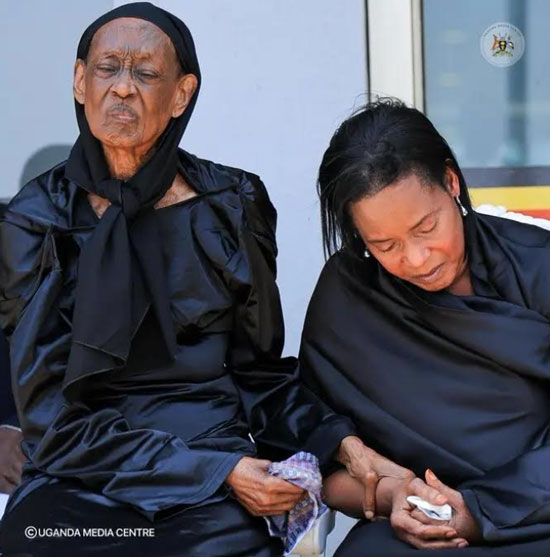
She had been both mother and guardian to a boy whose childhood was lived under the gaze of a kingdom
COVER STORY | THE INDEPENDENT | The first time Queen Mother Best Kemigisa, 59, accompanied a king home in death, she was a young widow. It was 1995.
Her husband, Omukama Patrick Olimi Kaboyo II, had died, leaving behind a three-year-old son who would soon inherit his throne. That boy was Oyo.
More than three decades later, on Friday afternoon, the Queen Mother, daughter of Prince Mujuku of the Batuku tribe of Rwebisengo in present-day Ntoroko district, accompanied another king to his final resting place. This time, the king inside it was her son.
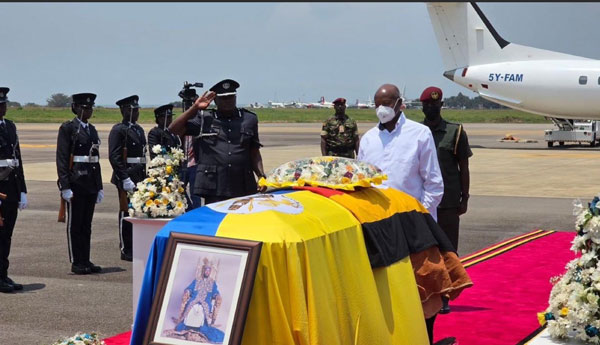
The aircraft carrying King Oyo Nyimba Kabamba Iguru Rukidi IV touched down at the Entebbe International Airport shortly after noon.
President Yoweri Museveni was waiting. So were members of the Tooro royal family, government officials, religious leaders and kingdom officials.
The casket was brought from the aircraft, covered in the flags of Uganda and Tooro. Best Kemigisa stood nearby.
There was something almost unbearable about the symmetry: the woman who had once become a widow while raising a child who had just become king was now mourning that same child, who had grown into a monarch and died at 34.
For nearly 31 years, she had been the person closest to the extraordinary story of Oyo’s reign. She had watched him become king. Now she was accompanying him home.
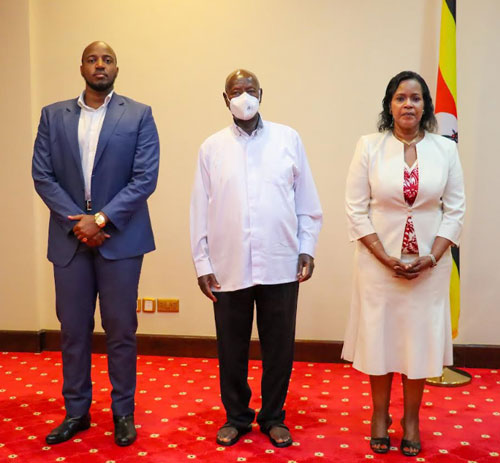
The airport ceremony was formal, but the grief was personal. Museveni laid a wreath on Oyo’s casket and paid his final respects. The President had known the king since childhood and had been among those who helped guide the monarchy during Oyo’s early years as a minor.
Speaking afterwards, Museveni recalled the efforts to save Oyo after the Queen Mother informed him of the king’s illness in November 2025.
The government supported his treatment first in Germany and later in the United States. But the efforts failed.
“Throughout his reign as King of Tooro, Oyo was a good person and a good leader,” Museveni said. “His passing is a great loss to the people of Tooro and Uganda.”
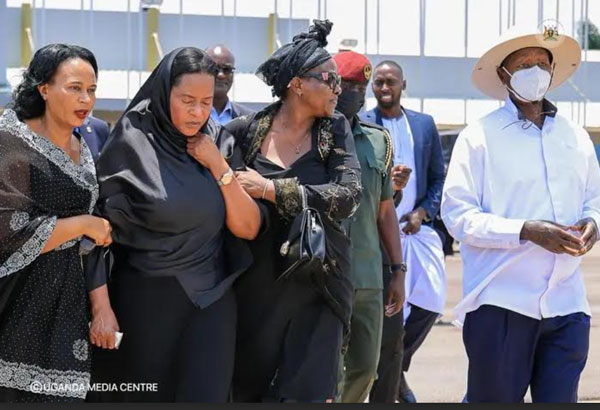
The President also described the king in almost familial terms, recalling that Uganda had watched him grow from a child into a monarch.
Then came the quieter part of the farewell.
The casket was moved towards the helicopter that would take Oyo home in Fort Portal, western Uganda. Best Kemigisa went with him. So did his sister, Princess Ruth Komuntale, her son and husband.
For the Queen Mother, the journey was taking her back into a history she had spent much of her life trying to carry.
A mother who buried a king
Best Kemigisa became a regent after the death of her husband in August 1995 and played a central role in guiding Oyo while he was still a child.
She had been both mother and guardian to a boy whose childhood was lived under the gaze of a kingdom.
Oyo’s coronation came less than three weeks after his father’s death. He was three. And, while the kingdom needed a king, the child needed a mother.
Best Kemigisa became both part of the institution that protected the crown and the parent who watched the boy beneath it grow up.
There were other losses too. In 1997, she lost her youngest daughter, Princess Cecilia Komukycya, who died at the age of four after battling leukaemia.
Now, nearly three decades later, she has lost Oyo.
Her only surviving child is Princess Ruth Komuntale, the Princess Royal of Tooro, who lives and works in the United States and travelled home with her brother’s remains.
The Queen Mother’s grief therefore carries the weight of an entire family history. She has seen a husband buried. She has buried a daughter. And now she is preparing to bury the son whose childhood and kingship became inseparable from her own life.
Kyegegwa
The helicopters flew west. At Kyegegwa, hundreds of people had gathered at Humura Playground. They had come to see the king.
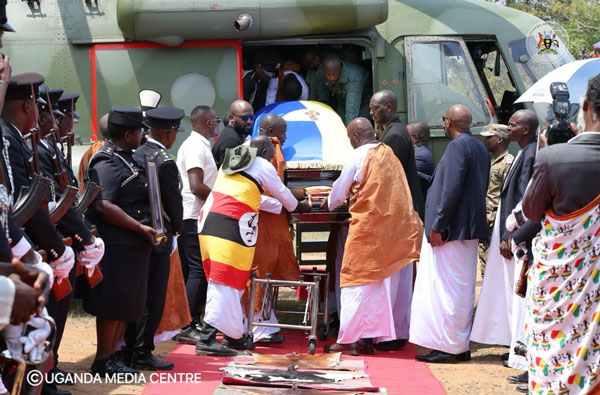
At about 2:30 p.m., the military helicopter carrying Oyo’s remains descended. The crowd watched as the casket was removed. Then the crying began.
For many, the death had remained something heard through radio announcements and conversations. The coffin made it real.
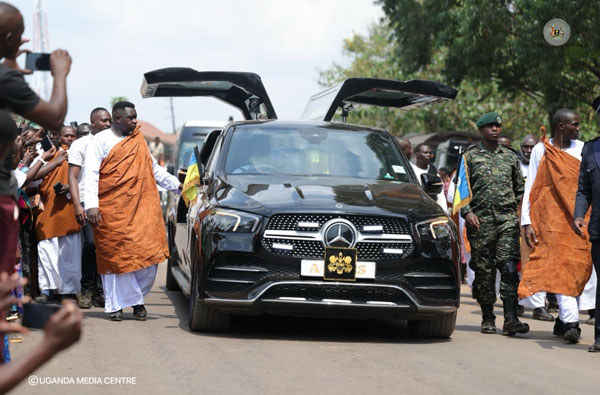
The pallbearers placed it into a waiting Mercedes-Benz hearse. Clergy prayed over the body before the convoy began the final road journey to Fort Portal.
Anna Mugisa, who was among those who witnessed the arrival, said she had struggled to accept that Oyo was dead.
“I struggled to believe that Oyo had died until I saw his casket,” she said. It was perhaps the simplest description of what was happening across Tooro. The people had known that their king was dead.
But now they could see him.
The road to Fort Portal
The hearse left Kyegegwa. It did not stop for formal ceremonies. Instead, it moved slowly through the communities along the route — through trading centres and villages where people had gathered since morning.
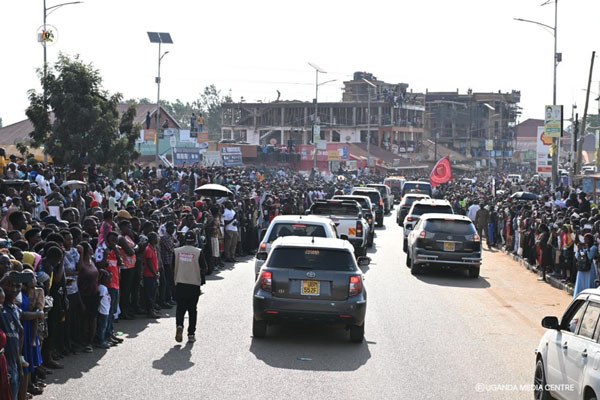
The road became a kind of open-air funeral. People stood outside shops. Boda-boda riders waited at stages. Children climbed onto walls and buildings.
Women stood by the roadside. Men held the Tooro flag. Some raised portraits of Oyo. Others simply watched.
The hearse passed through the communities towards Kyenjojo and then on towards Fort Portal, slowing enough for mourners to catch a final glimpse through the glass enclosure.
For almost five hours, the journey became a moving farewell. The kingdom was coming to the road.
Fort Portal
By evening, Fort Portal had changed. The city fell unusually quiet. From Mpanaga Market towards Karuziika Palace, thousands stood shoulder to shoulder, many of them having waited for hours. The silence was broken by wails, ululations and chants.
Some mourners had never met Oyo. They did not need to. He had been their king for almost their entire lives.
Peter Kyomuhangi remembered him as a king who cared about development, health and sport. Mwesige Beyamura spoke of a leader who promoted development and unity. And James Mwirumubi found the timing of the loss especially painful.
Oyo, he said, had begun engaging more actively with his subjects and championing development initiatives.
That was perhaps the tragedy of his final years: after growing up under the weight of a crown inherited as a child, he appeared increasingly ready to define the monarchy in his own terms.
Then he was gone.
The king they watched grow up
Oyo’s story was unusual because his subjects had not simply inherited him as king. They watched him become one. They saw the three-year-old. They saw the schoolboy. They saw the young man.
They watched him assume greater responsibility for a kingdom that had been placed on his shoulders before he could understand what responsibility meant.
Those who were children when Oyo was crowned are now parents themselves. Some have children who never knew another king.
His reign therefore became a measure of their own lives. For them, Oyo was not only the Omukama. He was a constant. And on Friday, that constant was passing away before their eyes.
The palace
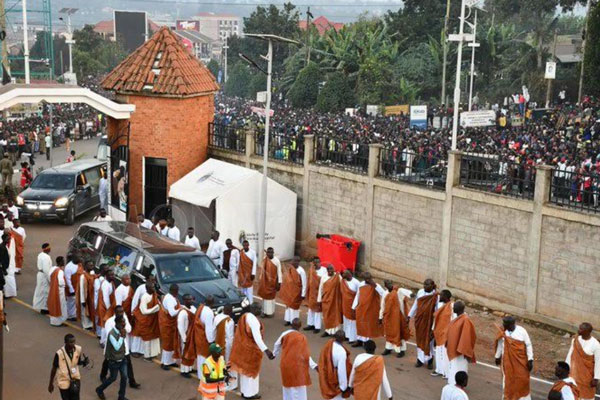
The procession finally reached Karuziika Palace. The road that had been filled with thousands of mourners narrowed into the ceremonial space of the kingdom. Traditional leaders waited. Royal officials gathered.
Omusuuga Charles Kamurasi Akiiki, head of the Babiito royal clan, and other clan leaders prepared to receive the remains.
The casket was received according to Tooro custom before the formal guard of honour. Then it was carried inside.
At about 7 p.m., after the long journey from Entebbe through Kyegegwa and along the roads of western Uganda, Oyo was finally inside his palace.
Home. But not as he had left it.
He would remain there in state during the nine-day mourning period, as prayers are held each evening before his burial at the Karambi Royal Tombs on September 12, the date that would otherwise have marked the 31st anniversary of his coronation.
The Queen Mother remains
For Best Kemigisa, the palace must hold a different meaning now. This was the place where her son was king.
The place where a three-year-old boy was brought into a history he had not chosen. The place where she helped protect his childhood. The place where he eventually became an adult monarch. And now the place where his body lies before burial.
She has spent much of her life standing beside the Tooro throne. First beside her husband. Then beside her son. Now both are gone.
Her daughter, Komuntale, remains, living thousands of miles away in the United States, but home now to mourn the brother with whom she shared the extraordinary childhood of a royal family.
For the Queen Mother, the journey that began at Entebbe was therefore more than the final movement of a king’s body.
It was a journey through her own life. At the airport, she watched her son leave the country for the last time. At Kyegegwa, she watched his people gather.
Along the road, she watched a kingdom say goodbye. At Karuziika, she watched the coffin disappear into the palace. And there, perhaps more than anywhere else, the meaning of the loss becomes clear.
Oyo came to the throne at three. His mother helped him survive the extraordinary burden of growing up as a king.
His people watched him become a man. On Friday, they watched him come home. And the woman who had once brought a child king into the palace was now bringing his body back to it.
The boy she raised became a king. The king became the story of a generation. And now, for the second time in her life, Queen Mother Best Kemigisa is burying a king.
*****
RELATED STORY